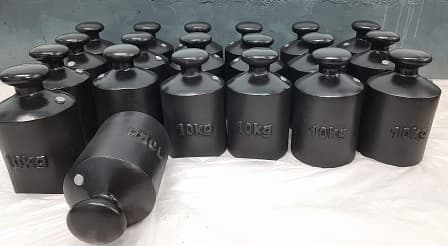
Test Weights: The Backbone of Accurate Weighing and Calibration
Test Weights: The Backbone of Accurate Weighing and Calibration
Introduction
In every industry where precision matters — from pharmaceuticals to manufacturing — the accuracy of weighing equipment is essential. Test weights play a crucial role in ensuring this accuracy. They are the standard reference tools used to verify, calibrate, and adjust weighing scales and balances, guaranteeing reliable measurements across applications.
What Are Test Weights?
Test weights, also known as calibration weights or standard weights, are precision-manufactured masses used to test and calibrate weighing instruments. They serve as a known standard against which a weighing device’s performance can be compared.
These weights are typically made of high-quality materials such as stainless steel, brass, or cast iron, depending on their application and required accuracy class.
Purpose of Test Weights
The primary purpose of using test weights is to:
- Verify that a weighing scale or balance provides accurate readings.
- Calibrate instruments according to international standards.
- Detect and correct errors due to drift, wear, or environmental factors.
- Maintain compliance with metrological regulations like OIML R111 or E2/M1 accuracy classes.
Types of Test Weights
Depending on the precision required, test weights are categorized into different accuracy classes:
Class
Typical Use
Material
E1 / E2
High-precision laboratory balances
Polished stainless steel
F1 / F2
General laboratory and industrial scales
Stainless steel or brass
M1 / M2 / M3
Industrial floor scales, weighbridges
Cast iron or stainless steel
Applications of Test Weights
Test weights are used in a wide range of industries:
- Pharmaceutical – Ensuring dosage accuracy and regulatory compliance
- Food & Beverage – Maintaining consistency in production and packaging
- Manufacturing & Logistics – Verifying weighbridges and platform scales
- Calibration Laboratories – For traceability and standardization
- Research Institutions – Ensuring precision in scientific measurements
Why Use Certified Test Weights?
Certified test weights are traceable to national or international standards, ensuring their credibility and accuracy. Using certified weights helps companies:
- Maintain ISO 9001 / ISO 17025 compliance
- Avoid financial loss due to inaccurate weighing
- Build trust and reliability in product quality
Material and Design Considerations
When selecting test weights, consider:
- Material: Stainless steel offers corrosion resistance; cast iron is cost-effective for heavy weights.
- Finish: Polished surfaces reduce contamination and wear.
- Shape: Cylindrical for laboratory use; rectangular or slotted for industrial applications.
Regular Calibration and Maintenance
Even the best test weights require periodic recalibration. Over time, dust, corrosion, and handling can alter their mass.
Recommended practice:
- Annual calibration at an accredited lab
- Proper storage in protective cases
- Avoid direct handling — use gloves to prevent contamination
Conclusion
Test weights may seem like small components, but they are fundamental to the reliability of every weighing system. Investing in high-quality, certified test weights ensures consistent performance, compliance, and confidence in every measurement — from the lab bench to the industrial floor.
About SWPI
At SWPI (Shanker Wire Products Industries), we manufacture and export OIML and NABL certified test weights in F2 to M3 accuracy classes, available in cast iron.
With over five decades of experience and exports to 40+ countries, SWPI continues to set the benchmark for quality and precision in the world of mass calibration.